
The reported sales
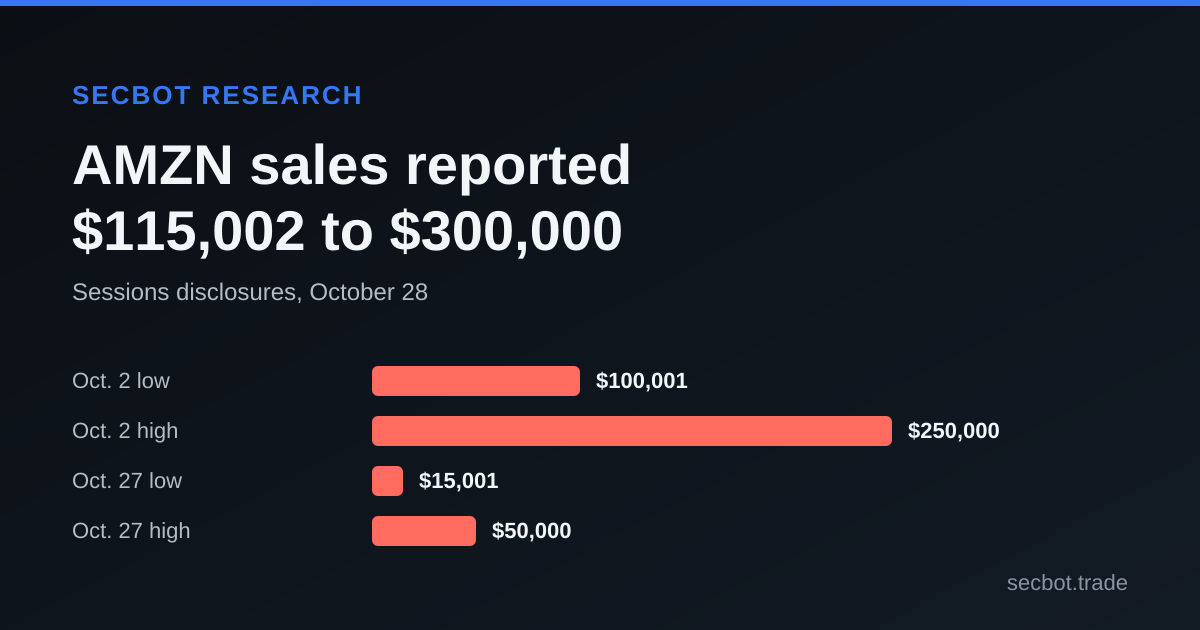
Pete Sessions reported two sales of Amazon.com stock, ticker AMZN, in disclosure records filed on 2026-10-27 and 2026-10-28. The transactions were dated 2026-10-02 and 2026-10-27. Their disclosed value bands combine to a range of $115,002 to $300,000. One line is marked as a transaction by Sessions' spouse, while the other is marked as not disclosed for owner.
The distinction between transaction date, filing date, and disclosure date matters here. The AMZN sale dated 2026-10-02 was filed on 2026-10-27 and became public on 2026-10-28. The later sale was dated 2026-10-27, filed that same day, and likewise appeared in the public record on 2026-10-28. In this dataset, those records carry reporting gaps of 25 days and 0 days respectively. The filing for the earlier trade arrived later, but both transactions were published together.
The dataset lists Sessions as a Republican member of the House from Texas. It identifies the instrument as stock for both AMZN entries. The records do not identify an option, nor do they provide a share count. Their reported values are ranges rather than exact transaction proceeds.
| Transaction date | Owner field | Reported value range | Reported trade price | Reporting gap |
|---|---|---|---|---|
| 2026-10-02 | spouse | $100,001 to $250,000 | $251.52 | 25 days |
| 2026-10-27 | not disclosed | $15,001 to $50,000 | $253.10 | 0 days |
What the range says
The lower end of the combined band adds the minimum reported amount in each record, producing $115,002. The upper end adds the two maximum endpoints, producing $300,000. That is a summary of the disclosed bands, not a claim that either transaction took place at an endpoint. The actual value could fall anywhere within each individual band, and the source does not provide a more precise figure.
This format limits what can be said about relative size. The October 2 entry has a higher listed range than the October 27 entry, but the exact proceeds are unknown. The earlier record represents a reported amount from $100,001 through $250,000. The later one represents a range from $15,001 through $50,000. It would be inaccurate to treat the midpoint of either band as a confirmed sale amount, or to derive a share quantity from the listed trade price.
The two trade prices in the records are $251.52 and $253.10. They are reported transaction prices, not a daily closing price series. The records do not state the number of shares involved, whether the trades were executed in one order or several, or whether any proceeds were reinvested. No return calculation follows from the values shown.
Other AMZN disclosure entries
Other congressional entries for AMZN in the retrieved records show why the owner field deserves attention. A disclosure by Ro Khanna lists a spouse sale and a child purchase dated 2026-09-04. Both show a trade price of $258.51, and each carries the reported range of $1,001 to $15,000. Those are separate entries with different owners and opposing transaction types. They do not establish the size of either person's total position.
Records for Michael McCaul also list spouse purchases of AMZN on 2026-08-20, 2026-08-21, 2026-08-25, 2026-08-27, and 2026-08-28. Each of those entries is marked as a purchase and falls within the reported range of $1,001 to $15,000. The transaction prices vary across the records, from $256.26 to $266.43. These examples supply context for how the same ticker can appear in reports from different households. They do not offset Sessions' sales, and they should not be read as a collective position or coordinated activity.
A separate sale of AMZN by Ro Khanna's spouse, dated 2026-09-04, appears alongside the child's purchase on that date. The dataset does not say whether the trades were related, whether they were made in the same account, or whether they changed an overall household exposure. It only records the owner category and transaction type supplied in the disclosure.
What these disclosures do not establish
A reported sale is not an explanation for why it occurred. These records contain no stated motive, no description of a portfolio plan, and no connection between a transaction and company information. They also do not establish whether the position was fully closed. A sale entry by itself cannot tell whether the reporting person or a household member kept other AMZN shares.
The label "not disclosed" is a missing owner attribution in the record, not proof that Sessions personally executed the transaction. The other sale is explicitly attributed to a spouse. These distinctions keep the report grounded in the filed fields rather than assumptions about who made a decision or controlled an account.
The public record also does not tell us what happened to AMZN's price after the transactions. The listed trade prices reflect the records' transaction fields. They should not be substituted for closing prices, or compared as if they were a complete series of market observations. This article does not infer performance from congressional trades.
Where to check the records
The congressional trades page provides a place to review public transaction disclosures across listed companies. The AMZN stock page provides company-specific SecBot coverage. Each view can help keep a reported transaction separate from company filings or market data, which answer different questions.
For these AMZN entries, the next useful public information point is another filing or disclosure that changes the record, such as a later transaction or a correction. Until then, the checked entries remain the October 2 and October 27 sales published on October 28, with reported value bands rather than exact proceeds. Register for SecBot to follow company and disclosure data as new records are added.