
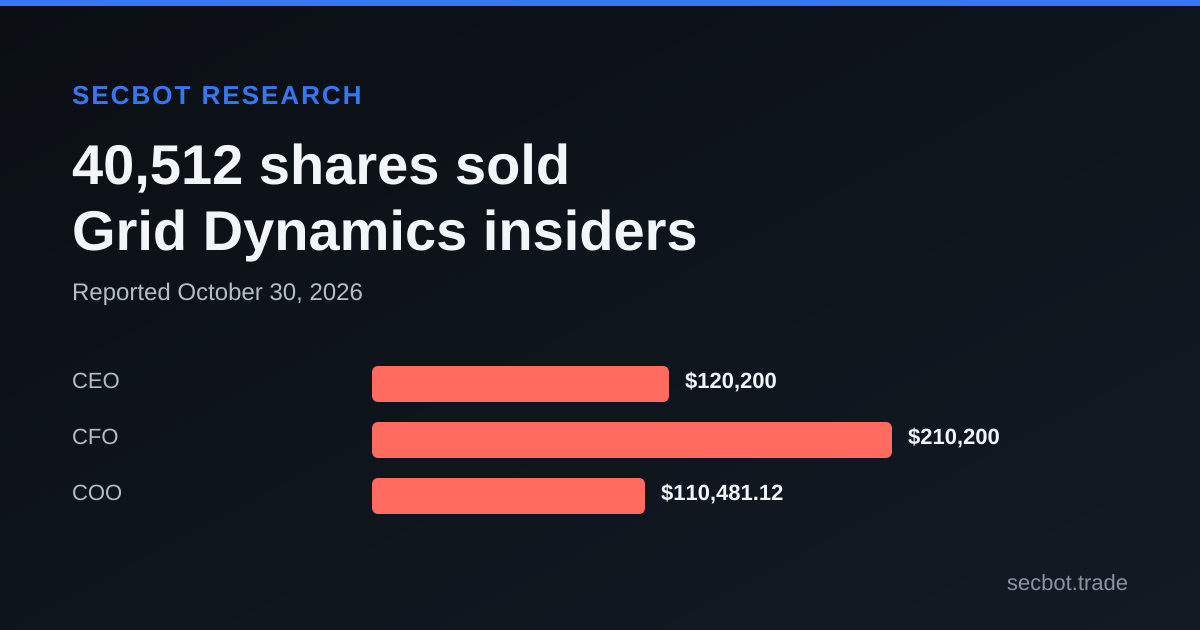
Three Grid Dynamics Holdings officers reported sales totaling 40,512 shares on October 30, with transaction values adding up to $440,881.12. The sellers were Chief Executive Officer Leonard Livschitz, Chief Financial Officer Anil Doradla and Chief Operating Officer Yury Gryzlov. Each of the three Form 4 rows identifies the transaction as a sale under a Rule 10b5-1 trading plan, a prearranged plan for securities transactions.
The three reported transactions
The filings show three different sale sizes and reported share prices. Doradla sold 20,000 shares at $10.51 per share, for a reported value of $210,200. Livschitz sold 10,000 shares at $12.02 per share, with a reported value of $120,200. Gryzlov sold 10,512 shares at $10.51 per share, valued at $110,481.12. The combined values and share count in the table are arithmetic totals of those three Form 4 entries.
| Officer | Shares sold | Reported price per share | Reported value |
|---|---|---|---|
| Anil Doradla, CFO | 20,000 | $10.51 | $210,200 |
| Leonard Livschitz, CEO | 10,000 | $12.02 | $120,200 |
| Yury Gryzlov, COO | 10,512 | $10.51 | $110,481.12 |
| Total | 40,512 | $440,881.12 |
The transaction rows record October 30, 2026 as the transaction date. The three Form 4 filings appear in the local filing data on October 31, 2026. The distinction matters: the sale date is when the transaction is reported to have taken place, while the filing date is when the disclosure entered the record. The sales are not identical in size, price or reported remaining shares. After the transactions, the rows show 3,299,560 shares for Livschitz, 374,509 for Doradla and 484,778 for Gryzlov.
Plan details in the disclosures
The Form 4 entries identify all three sales as plan transactions, but their footnotes provide different adoption dates for the plans. The disclosure for Livschitz and Doradla gives one matching adoption date, while Gryzlov's footnote gives a different date. Those statements describe the plans associated with the respective sales; they do not state why the officers chose the sale amounts or what they intend to do with the proceeds.
The CEO's reported transaction has a further detail in a separate Form 144 filing. A Form 144 is a notice of a possible sale, rather than proof by itself that a transaction occurred. The local filing analysis states that Livschitz filed notice of intent to sell 10,000 shares, with an estimated market value of approximately $120,198 based on $12.0198 per share. The October 30 Form 4 then records the sale of 10,000 shares for $120,200 at $12.02 per share. The two records are close in reported value, but they are separate documents with different functions. The Form 4 is the transaction report.
Trading around the disclosures
Grid Dynamics closed at $8.75 on October 28, then at $9.49 on October 29. On October 30, the closing price was $13.36. That final close was 40.78% above the October 29 close, a calculation based on those two daily closing prices. The daily price data also show October 30 opened at $10.47 and reached a high of $13.39, with reported volume of 8,570,300 shares. On October 29, reported volume was 4,389,400 shares, with a closing price of $9.49.
These market figures give context to the timing, but they do not establish that the insider reports caused the stock's price movement. The reports specify transactions and plan status. They do not explain price changes, identify the buyers on the other side of the trades or attribute any market response to the filings. Nor should the reported transaction price be treated as a daily closing quote. The rows list $10.51 for Doradla and Gryzlov, and $12.02 for Livschitz, while exchange data provide separate session-level prices.
Other recent activity
The insider data also include a separate sale by Livschitz on October 29. He reported selling 10,000 shares at $9 per share, a transaction value of $90,000, also marked as a Rule 10b5-1 plan transaction. That row lists 3,309,560 shares after the sale. The next day's row lists 3,299,560 shares after another 10,000-share sale. This sequence is visible in the transaction records, though the records do not provide an account-level explanation beyond the stated plan status.
The company also filed a 10-Q on October 30, according to SecBot's filing index. The index entry provides the form type and filing date, but no completed analysis of the document was returned with the result. This post therefore does not infer financial results or business developments from that filing. The local record confirms that an additional company filing coincided with this period of insider disclosures, but it does not show a relationship between the filing and the officers' transactions.
What the records do not establish
An insider sale is not necessarily a statement about the company's prospects. The Form 4 entries do not state the sellers' motives, the use of proceeds or whether an officer's financial position changed beyond the reported share balances. Plan designation is material context, but it does not make the transaction disappear from the record or tell readers what motivated the plan when it was adopted.
The share balances are the amounts reported after the specific transactions. They do not establish an officer's complete economic exposure through other accounts, awards or derivative securities. The records also do not establish whether the selling officers acted together. The fact that three officers had reported sales on the same date is a descriptive observation, not evidence of coordination. The transactions differ in size, price and plan adoption date.
Price context is similarly limited. The daily candles report session opening, high, low and closing prices alongside volume. Those values do not identify intraday counterparties or explain what news was reflected in trading. The available figures provide a snapshot through October 30, not a full account of activity after that session.
What to monitor in the public record
The practical follow-up is whether later insider disclosures show further transactions, changed share balances or other transaction codes. Form 4 data distinguish sales from grants, tax withholding and other types of activity, so those categories should not be treated as interchangeable. Updates to the company's SEC filing record can also add context, though this dataset's October 30 10-Q entry did not include analyzed results.
The related GDYN stock page provides the company-level view, while the insider tracker organizes reported officer and director activity. The latest daily candle returned here is October 30, 2026, when Grid Dynamics closed at $13.36. More market and filing data are available with a SecBot account.