
Two Navy awards in four days
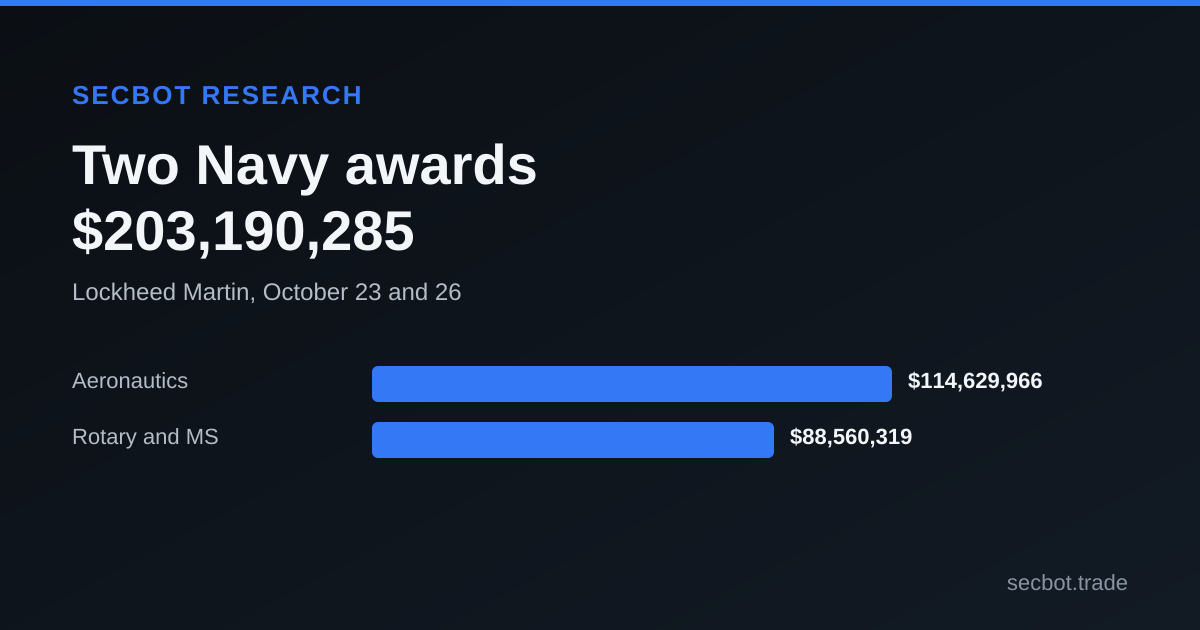
Lockheed Martin appeared in federal contract records for two Navy awards dated October 23 and October 26, with stated values totaling $203,190,285. The larger entry, dated October 23, is a $114,629,966 order for Lockheed Martin Aeronautics. The October 26 entry is an $88,560,319 contract for Lockheed Martin's Rotary and Mission Systems business. Together the entries represent two distinct contract actions, not a single combined program.
The October 23 award is a cost-plus-fixed-fee order against a previously issued basic ordering agreement. The Navy award record identifies the recipient as Lockheed Martin Aeronautics Co. in Fort Worth, Texas. It lists award ID N0001927F1037 and says the order was placed against basic ordering agreement N0001924G0010. The record describes an order against an existing agreement. It does not provide a delivery schedule or a breakdown of the work's costs.
The October 26 contract is described as a cost-plus-fixed-fee, indefinite-delivery/indefinite-quantity contract for the Radiant Mercury program. Its award ID is N6600127D0006. The record names Lockheed Martin Corp., Rotary and Mission Systems, in Littleton, Colorado. This is a different business unit and contract structure from the Aeronautics order. The entry gives an announced value of $88,560,319, but does not specify in the returned record how much work has already been ordered under the contract.
Comparing the disclosed values
| Award date | Business | Stated value | Contract description |
|---|---|---|---|
| October 23 | Aeronautics | $114,629,966 | Cost-plus-fixed-fee order |
| October 26 | Rotary and Mission Systems | $88,560,319 | Cost-plus-fixed-fee, indefinite-delivery/indefinite-quantity contract |
| Combined | Two separate entries | $203,190,285 | Sum of the two stated values |
The total is an addition of the values in the two federal contract records, not an additional amount announced by the Navy. The Aeronautics entry is $26,069,647 larger than the Rotary and Mission Systems entry. That comparison is arithmetic only. The award records do not establish that one order is more profitable or more strategically important than the other.
Contract form matters when reading the amounts. A cost-plus-fixed-fee label identifies the stated contract type, while an indefinite-delivery/indefinite-quantity label identifies the structure attached to the Radiant Mercury contract. The available entry does not report a minimum purchase or a schedule of future orders. The stated contract value therefore should not be treated as revenue or cash already received, because the records provide no such financial measure.
The federal records label both amounts as announced values. SecBot's contract data distinguishes a base award value from a later modification's new obligation, because those amounts represent different things. Neither of these two records is presented as a modification. Readers should still distinguish the stated contract amount from revenue recognition, profit, or the timing of cash flows, none of which is supplied in these award entries.
Separate programs and operating groups
The company attribution in the records spans two operating groups. Aeronautics is identified with the October 23 order, while Rotary and Mission Systems is identified with the October 26 award. This creates a reported contract pattern across two units rather than two awards for the same unit. The program names and contract structures also differ: one record refers to an order against an existing basic ordering agreement, and the other names Radiant Mercury under an indefinite-delivery/indefinite-quantity contract.
That distinction is useful for keeping the scale of the disclosures in perspective. The combined total gives a compact measure of the two announced values, but it does not mean the company won one $203,190,285 project. Nor does the timing alone prove the awards are linked. The contract descriptions do not state a common mission, shared deliverable, or operational connection between these orders. The supported description is that two Navy awards naming Lockheed Martin business units entered the records on separate listed dates.
The order tied to Aeronautics is the larger of the two disclosed amounts, while the Radiant Mercury contract adds a second award on the later listed date. The gap between the values is $26,069,647. No comparison with prior Lockheed Martin contracts is made here because the rows retrieved for this report do not establish a consistent comparison set by contract type, period, or business unit. A larger award amount alone does not establish a change in the company's overall award pace.
What the records do not establish
These disclosures are evidence of federal awards, not a full financial forecast. They do not say when the work will be performed, how much of the stated amount is immediately funded, or what share of the contract will ultimately be recognized as sales. The October 26 entry's indefinite-delivery/indefinite-quantity form makes it important not to assume that the listed value equals orders already placed. The record also does not give a margin, expected cash contribution, or a comparison with the company's other customer work.
The entries do not establish whether either award changes Lockheed Martin's annual outlook. They give no contract backlog reconciliation and no management commentary. A contract announcement can matter to the relevant business, but its significance for consolidated results cannot be derived from the face amount alone. Likewise, these two rows do not provide evidence about the company's stock performance or explain any market reaction.
The government-contract records are not an exhaustive account of every award or modification. The dataset describes accumulated, locally ingested contract actions and says coverage is non-exhaustive. The absence of another award in this set would not prove that no other contract activity occurred. The amounts and descriptions above are limited to the two returned Lockheed Martin entries.
What to track next
The next useful evidence would be a later contract record that identifies an obligation or modification, because it could clarify whether a framework award is followed by specific funded work. For the October 26 Radiant Mercury contract, a later public description of any subsequent action would help distinguish the stated contract structure from the timing and scale of orders actually issued. For the October 23 Aeronautics order, a later record may add detail about execution, but the current entry itself provides no schedule.
Readers can follow company-specific filings and contract developments on the Lockheed Martin stock page and browse SecBot's market research reports. The next fact to watch is a dated award modification or order record that updates the funding or scope attached to either award. For more SecBot research and data views, create an account.