
FTC and state partners target Toast
The Federal Trade Commission and state partners announced an enforcement action involving Toast on October 29, 2026. The action names Toast and concerns allegations about fees and subscription practices. The agency's headline also describes allegations about how Toast presents costs, with a reference to its "24/7/365" customer support. The announcement is a lawsuit and allegations, not a finding in the material available here.
The action is concrete, but the locally stored record is brief. It identifies the FTC and the People of the State of California by way of the Los Angeles County Counsel and San Francisco in its description. That text ends before giving further details. It does not state a requested penalty. It does not give the number of affected customers, the amount of fees in dispute, or a court timetable. This distinction matters: the headline communicates the subject of the case, while the record available here does not establish the allegations as proven or quantify potential financial exposure.
Readers can follow Toast company coverage on the TOST stock page and follow enforcement-related records through the SEC filings page. Those pages provide broader SecBot coverage, but the facts discussed here come from the local enforcement and filing rows returned for this report.
What the record actually says
The enforcement record classifies the matter as an FTC enforcement action. Its title describes allegations about fees said to be hidden or unauthorized. It also points to alleged deceptive subscription practices and cancellation practices. The description characterizes the claims as agency allegations. The title and description do not reproduce a complaint or a company response, so they cannot settle disputed facts.
One detail highlighted in the description is the "24/7/365" customer support claim. The stored record does not explain the support standard at issue. It does not identify individual customer experiences or provide the wording of any challenged sales disclosure beyond that short phrase. Nor does it say whether the action addresses all Toast products or a particular product or customer group. A careful account therefore should stay with the subject labels the enforcement record supplies, rather than filling those gaps with assumptions.
There is also no fine amount in this row. It would be inaccurate to describe a quantified penalty or say that Toast has already paid damages based on the information returned. The available item establishes that an action was announced and identifies its allegations. It does not report an adjudicated outcome.
Toast's stock around the announcement
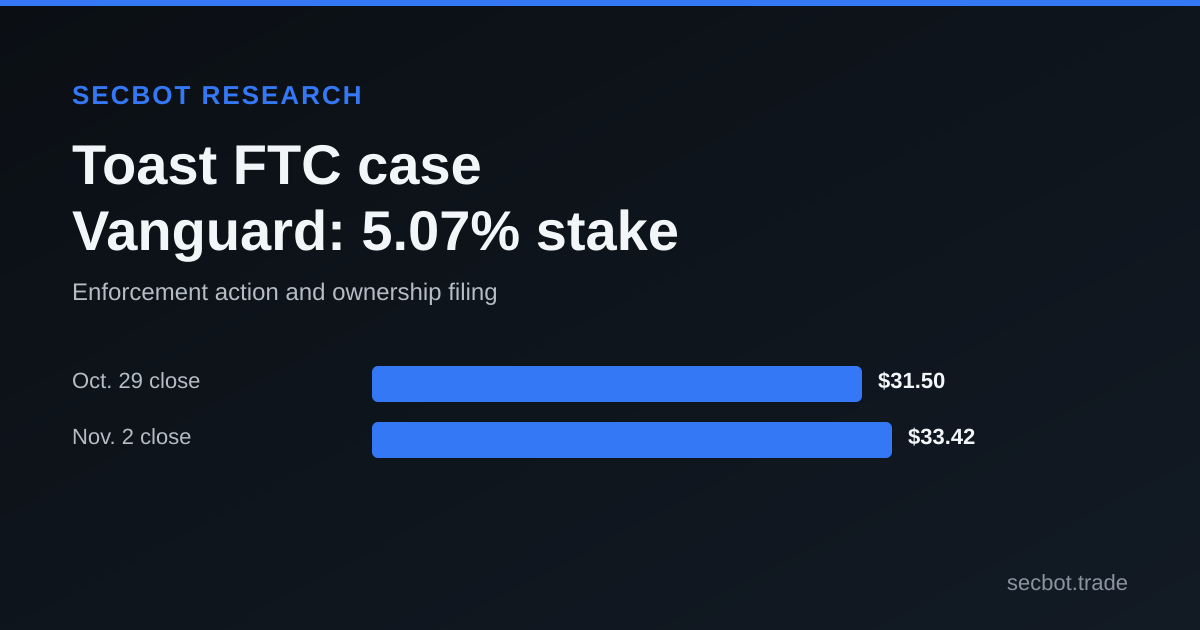
The daily price history shows Toast closing at $31.50 on October 29, the date of the enforcement action, then at $33.42 on November 2. That is a $1.92 increase, or 6.10%, between those closes. The change is a simple price comparison, not proof that the enforcement announcement moved the stock. The dataset does not identify the cause of the price move.
The November 2 session recorded a $32.17 open and a $34.66 high. Its low was $32.12 before the $33.42 close. Volume was 11,383,600 shares. The October 29 record lists a $31.92 open and a $32.55 high. Its low was $30.82 before the $31.50 close, with 12,880,000 shares traded. These session figures supply context for the two closes but do not explain who traded or why.
| Date | Close | Volume |
|---|---|---|
| October 29, 2026 | $31.50 | 12,880,000 |
| November 2, 2026 | $33.42 | 11,383,600 |
The enforcement announcement date and the price observations overlap in time, but chronology alone cannot establish a market response. The local price series supplies daily OHLCV figures, a shorthand for session pricing and volume. It does not offer an event study or isolate the effect of a particular headline. The percentage comparison should be read in that limited way.
A separate ownership filing
A Schedule 13G filed on October 30 adds another disclosure to the Toast record, but it is separate from the enforcement action. The filing report says Vanguard Capital Management disclosed beneficial ownership of 26,107,633 shares of Toast Class A common stock, equal to 5.07%. The report describes the filing as a new passive disclosure and says Vanguard certified passive intent under Rule 13d-1(b). It is not described as an activist filing.
The reported ownership number is a snapshot, not a transaction made on the filing date. The record does not say that Vanguard's position changed because of the FTC action. The two records are useful company context because they concern Toast in close succession, but they describe separate events: one is a regulatory lawsuit announcement and one is an ownership disclosure.
The filing report says the Schedule 13G describes passive intent, rather than intent to change or influence control. It also mentions other passive filings in its summary, but the locally returned item does not provide complete comparable ownership histories for those holders. The 5.07% figure should not be treated as a forecast of future purchases or sales.
What remains unknown
The enforcement row does not give a docket number, a response from Toast, or a ruling. It provides no customer count. It gives no fee total or requested remedy. Those absences put a clear limit on how much can be inferred about the company's operating exposure from this record alone. The allegations concern pricing presentation and subscription practices, but the row does not establish how widely those practices were used.
The stock history does not identify the reason for its close-to-close change. It cannot show whether traders were responding to the lawsuit. It does not link the price move to the ownership filing or to broader market movement. No causal interpretation follows from the fact that the close on November 2 was higher than the close on October 29.
The ownership disclosure likewise does not provide daily position movements. It reports the share count and percentage attributed to Vanguard. Its passive classification does not show what Vanguard may report in a later filing. The data also does not establish any relationship between Vanguard and the enforcement matter.
The next useful datapoints
The next substantive developments would be a fuller public record of the case, any response from Toast, or a later procedural update. For the ownership disclosure, a subsequent filing would be needed to compare the reported stake with a new snapshot. None of those outcomes is supplied in the records reviewed here. For now, the dated record is specific: the FTC and state partners announced allegations on October 29, and the Schedule 13G reported Vanguard's 5.07% stake.
For more SecBot company and filing coverage, visit SecBot.