
The quarterly report had two different signals
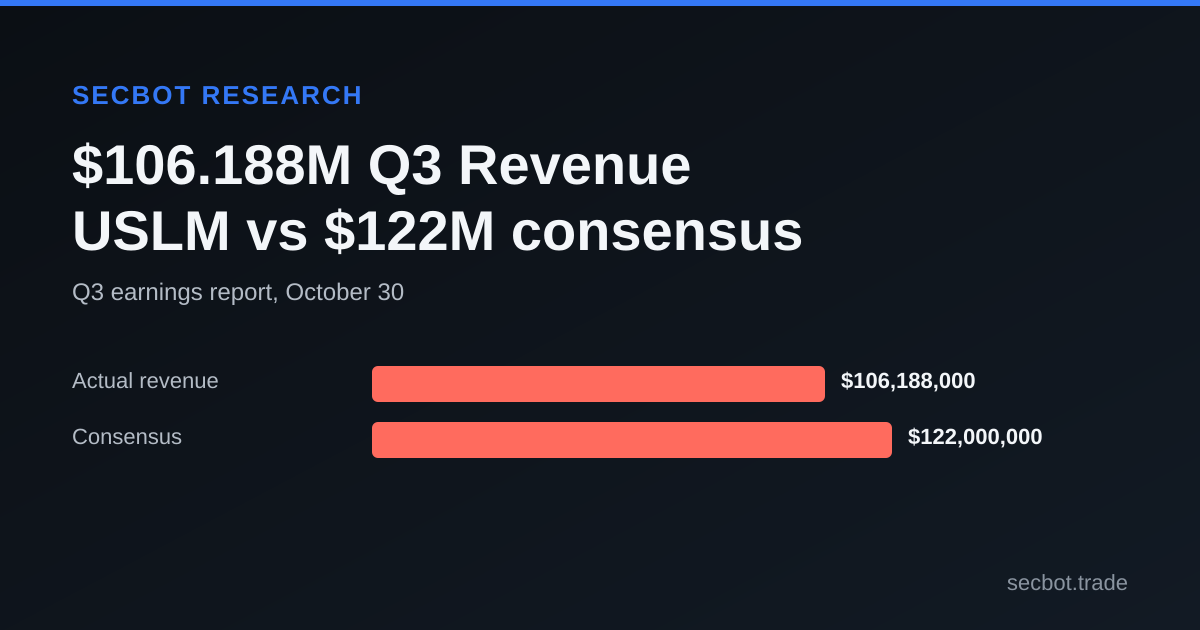
United States Lime & Minerals reported Q3 2026 revenue of $106.188 million, up 4.1% from Q3 2025. Yet the revenue figure was below the $122 million consensus estimate, while diluted earnings per share of $1.32 also missed the $1.48 estimate. Its earnings release appeared on October 30. The divergence matters: sales growth versus the prior year did not translate into an estimate beat, and the company's own reported cost pressures provide context for the gap.
SecBot's analysis marked both revenue and earnings per share as misses. It recorded a revenue surprise of -12.96% and an EPS surprise of -10.81%. The estimate comparison is straightforward: reported revenue was $106.188 million against $122 million, and reported EPS was $1.32 against $1.48. These comparisons describe the quarter against estimates, not against the company's prior-year results. On the year-over-year measure, the report instead shows revenue growth alongside lower gross profit and net income.
The original filing record gives the timing and form context. A Form 8-K carrying earnings-release items was filed on October 30, followed by a Form 10-Q filing that day. The filings page and earnings page provide the places to follow those records: USLM filings and company data and earnings coverage.
| Q3 2026 measure | Reported | Comparison |
|---|---|---|
| Revenue | $106.188 million | $122 million consensus |
| Diluted EPS | $1.32 | $1.48 consensus |
| Gross profit | $50.8 million | Down 2.7% year over year |
| Net income | $38.0 million | $38.8 million in Q3 2025 |
Revenue increased, while profit measures weakened
The report's year-over-year figures show a contrast in the company's operating results. Revenue grew 4.1%, but gross profit declined 2.7% to $50.8 million. Net income was $38.0 million, compared with $38.8 million in Q3 2025, a decline of 1.9%. The earnings analysis lists a net margin of 35.8%, gross margin of 47.8% and operating margin of 42.1% for the quarter. Those three ratios are snapshots for Q3, not direct comparisons with the prior-year margin figures, which are not supplied in the retrieved report.
The pattern narrows the story. This was not a quarter in which sales fell year over year. Instead, the available figures show modest revenue growth accompanied by lower gross profit and net income. The consensus miss adds another comparison: actual sales were below analysts' expected level even as revenue exceeded the prior year's level. The data does not provide product-level sales, customer volumes or realized pricing, so it cannot establish which part of the business drove the difference between year-over-year growth and the missed estimate.
Revenue and EPS are different measures. Revenue is reported in dollars across the whole company; EPS expresses earnings per share. Neither comparison by itself explains the cause of the miss. The source analysis attributes pressure to higher diesel costs and production inefficiencies tied to the new Texas kiln, rather than to a fall in reported revenue.
Diesel costs and the Texas kiln are the stated pressures
Higher diesel costs appear among the report's notable items. The analysis also cites integration inefficiencies at the new Texas kiln. The filing analysis says the kiln began intermittent production in Q3 and that final commissioning was expected in Q4. Commissioning refers to the remaining work to bring a facility or system into its intended operating state. The record therefore connects the facility's ramp-up period to the quarter's cost discussion, but it does not quantify the portion of expense or lost output attributable to the kiln.
The release analysis states that gross profit was $50.8 million, down 2.7% year over year. It does not break out how much of that change came from diesel, kiln operations or any other cost category. Likewise, the stated net income comparison shows a $38.0 million result against $38.8 million in the prior-year quarter, but the available report does not provide a full bridge from revenue to net income. That limits how precisely readers can assign the decline to a particular cause.
The analysis also records a regular quarterly dividend of $0.06 per share, described as maintained. That is a separate capital-return detail rather than an explanation of the earnings result. The documents retrieved do not provide additional cash-flow figures or a company forecast, so the dividend should not be treated as a proxy for the direction of future operating results.
What the stock record can and cannot add
The daily price history in SecBot data gives a limited market backdrop around the report. USLM closed at $113.89 on October 29 and $111.61 on October 30. The October 30 daily record lists a high of $115.27 and a low of $111.34. Those are exchange-session observations, while the earnings release and filings were timestamped later on October 30. The timing means the daily close does not measure a full regular-session response to the published report.
A separate quote retrieved after the regular session showed $106.40 at 22:05 UTC on October 30, with a previous close of $113.89 and a reported change of -4.668%. That quote is a post-session observation, not the October 30 daily candle close. Keeping the two records distinct matters: the candle records the regular session, while the quote is tagged post-session. The available figures do not identify the specific trading activity or participants behind the post-session move.
The filing entry and the analyzed earnings release repeat the same central Q3 figures. That repetition offers a cross-check within SecBot's records, but it is not an independent company result. The retrieved analyst-data query returned no rows for USLM. Therefore this review relies on the consensus figures embedded in the analyzed release report and does not present a separate analyst-action history.
What to watch in the next company report
The evidence at hand leaves a defined set of unanswered operational questions. The report says the Texas kiln moved into intermittent production during Q3 and gives Q4 as the expected period for final commissioning. A later company filing can establish whether the work was completed and whether the company described a change in production efficiency. It can also provide additional detail on diesel-related cost pressure, if disclosed. Until such detail appears, the record supports reporting the cited pressures, not estimating their future duration or size.
The same caution applies to the consensus miss. SecBot's report gives estimates of $122 million in revenue and $1.48 in diluted EPS, but the retrieved material does not provide the individual estimates behind those consensus numbers. It also does not show revisions after the release. No conclusion about subsequent estimate changes or future results follows from this data alone.
The next concrete checkpoint in the retrieved record is the Q4 kiln commissioning expectation stated in the October 30 filing analysis. The data does not provide a scheduled date for the next earnings report. The earnings and filings pages will carry later company disclosures as they enter SecBot's records. For access to SecBot research, register here.