If you trade stocks, you have probably noticed how much noise sits between you and a good decision. There are podcasts, hot takes on social media, analyst notes that all somehow contradict each other, and a friend who swears he has a system. Most of it is opinion dressed up as research. SEC filings are the opposite of that. They are the closest thing to ground truth that a trader can actually get, and learning to read them is one of the highest leverage habits you can build.
I want to make the case for treating filings as your starting point rather than something you check after you have already made up your mind.
What a filing actually is
When a public company communicates with the Securities and Exchange Commission, it does so through standardized documents that get posted to a public database called EDGAR. Anyone can read them for free. The important part is not that they exist, it is that they come with legal weight behind them. Executives sign these documents. If a company lies in a filing, that is not a bad look, it is potential securities fraud with real consequences.
Compare that to an earnings call where a CEO can talk in vague, optimistic language, or a press release written by the marketing team to sound as upbeat as possible. The filing is where the company has to actually show its work.
Why this matters for trading specifically
A stock price is a bet on the future, but that bet has to be anchored to something real. Filings give you the real thing. Here is what you get that you cannot get anywhere else with the same reliability.
You get the unfiltered numbers. Revenue, margins, debt, cash on hand, and how all of that is trending over time. The headline number a company puts in its press release is often the flattering one. The filing contains the footnotes that explain how they got there.
You get risk straight from the source. Companies are required to disclose the things that could go wrong. This section can feel like boilerplate, but when a new risk shows up that was not there last quarter, that is a signal worth paying attention to.
You get a record you can compare. Because filings follow a consistent structure quarter after quarter and year after year, you can line them up side by side. A story changes slowly in filings, and noticing the change is where a lot of the edge lives.
The filings worth knowing by name
You do not need to memorize the entire alphabet soup, but a handful come up constantly.
The 10-K is the annual report. It is long, it is detailed, and it is where you go when you want to genuinely understand a business rather than just react to it.
The 10-Q is the quarterly version. Shorter, less polished, but it keeps you current between the big annual updates.
The 8-K is the one traders should watch most closely in real time. It is filed when something material happens, like a leadership change, an acquisition, a big customer loss, or a restructuring. These can move a stock fast, and the 8-K often hits before the news cycle fully catches up.
Form 4 tells you when insiders buy or sell their own company's stock. An executive loading up on shares with their own money is a different signal than one quietly selling. It is not a guarantee of anything, but it is information you would want.
The 13F shows what large institutional investors are holding. It is delayed, so it is more of a rearview mirror than a windshield, but it tells you where the big money has been positioning itself.
The DEF 14A, or proxy statement, covers executive pay, board structure, and shareholder votes. If you want to know whether management's incentives are actually aligned with shareholders, this is where you look.
How to use them without drowning
The mistake people make is trying to read a 10-K cover to cover like a novel. You will burn out and learn nothing. A better approach is to read with questions in mind.
Start with what changed. Pull this quarter's filing next to last quarter's and look for what is different in the language and the numbers. Companies rarely announce bad news loudly, but they are required to write it down somewhere.
Read the management discussion section, often called the MD and A. This is where the company explains its own results in plain language, and the gaps between what they emphasize and what they downplay are revealing.
Check the cash flow statement, not just the income statement. A company can report a profit on paper while bleeding actual cash, and the cash flow statement is where that shows up.
Skim the risk factors for anything new. Treat a freshly added risk as something the company felt legally obligated to warn you about.
Letting a tool do the heavy reading
Here is the honest tension. Everything above is true, and almost nobody has time to actually do it. There are thousands of companies, each filing several documents a year, and the material changes are buried inside hundreds of pages of careful language. Reading filings the right way is a real edge, but it is also a real time sink.
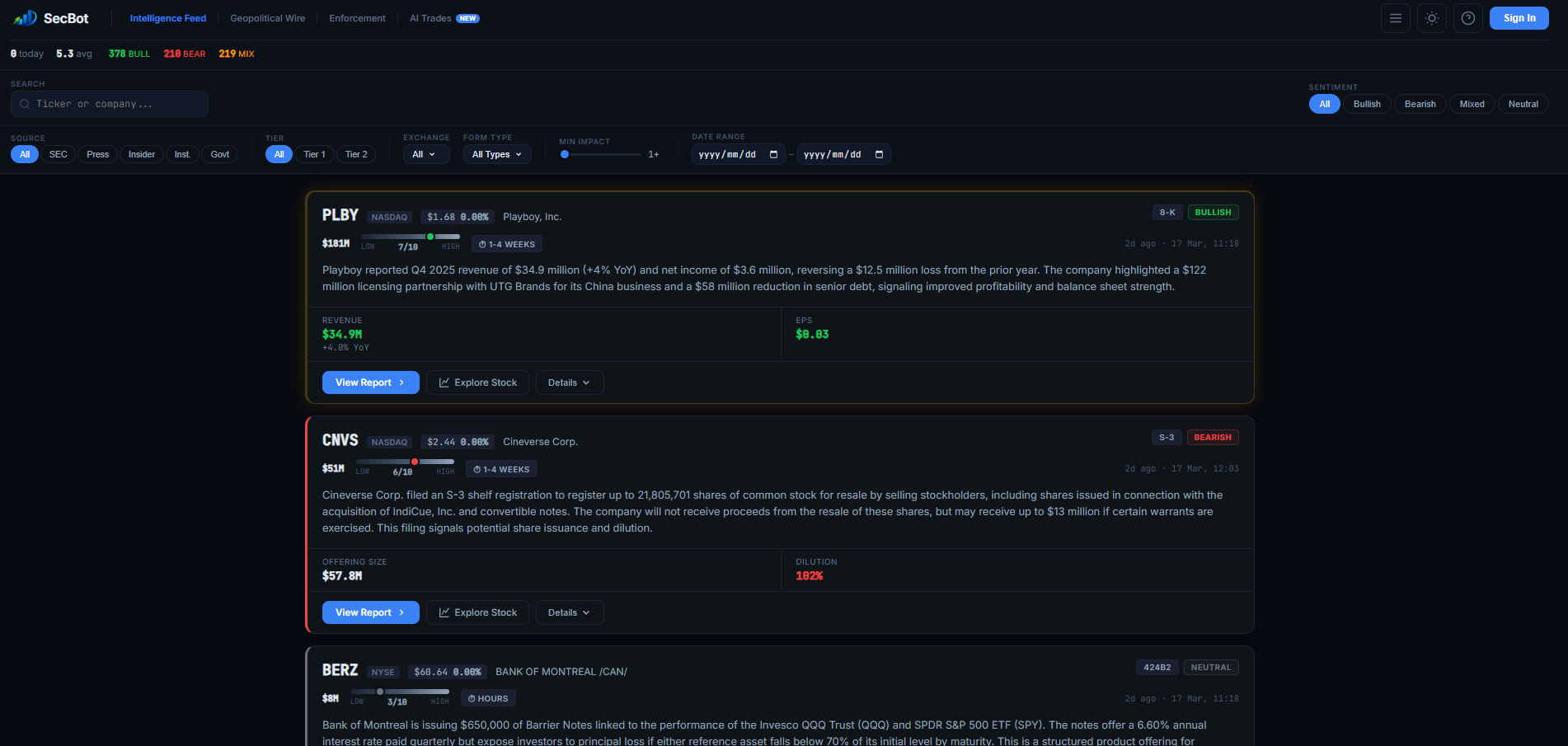
This is where a service like secbot.trade earns its place in a trader's workflow. The idea is simple. Instead of you opening EDGAR, downloading a 10-K, and hunting for what changed since last quarter, it reads and parses the filings for you and hands back the structured, searchable result.
In practice that means it ingests the full range of documents we talked about, the 10-Ks and 10-Qs, the 8-Ks that move stocks in real time, Form 4 insider buys and sells, 13F institutional holdings, proxy statements, and S-1s, and turns each one into clean data rather than a wall of text. You can run a full-text search across everything at once, so a question like "which companies just added a new risk about a key supplier" becomes a query instead of a weekend.
It does not stop at the filings either. The same platform pulls in the context that sits around them, things like analyst ratings and price targets, upcoming catalysts and earnings dates, congressional trades, regulatory enforcement actions, government contract awards, insider and institutional activity, plus market signals and sentiment. So you get the primary source and the surrounding picture in one place, which is usually what you actually need to make a call.
The point is not to replace your judgment. It is to remove the part of the job that is pure manual labor, the reading, parsing, and comparing, so the time you spend is spent on thinking rather than scrolling. You still decide what the facts mean. The tool just makes sure you are looking at all of them.
A fair warning
Filings are honest, but they are not the same as easy. They are written by lawyers and accountants who are incentivized to be accurate without being alarming. The information is there, but it is sometimes buried in careful phrasing. Learning to read between the lines takes practice, and your first few 10-Ks will feel like work. That is normal. The skill compounds.
They are also not predictive on their own. A filing tells you what is true and what has happened, not what the stock will do tomorrow. Plenty of great businesses have overpriced stocks and plenty of struggling ones are cheap for a reason. Filings give you the facts. Turning facts into a good trade is still on you.
The bottom line
Every other source you rely on, the analyst, the newsletter, the influencer, is ultimately working from these documents too, just with their own spin added on top. When you read filings yourself, you skip the middleman and you form your own view from primary evidence. In a market full of people trading on stories, being the person trading on the actual record is a quiet but durable advantage.
So before you act on the next tip, go to the source. Pull up EDGAR yourself, or let secbot.trade read and parse it for you. Either way you are trading on the actual record instead of someone else's story.